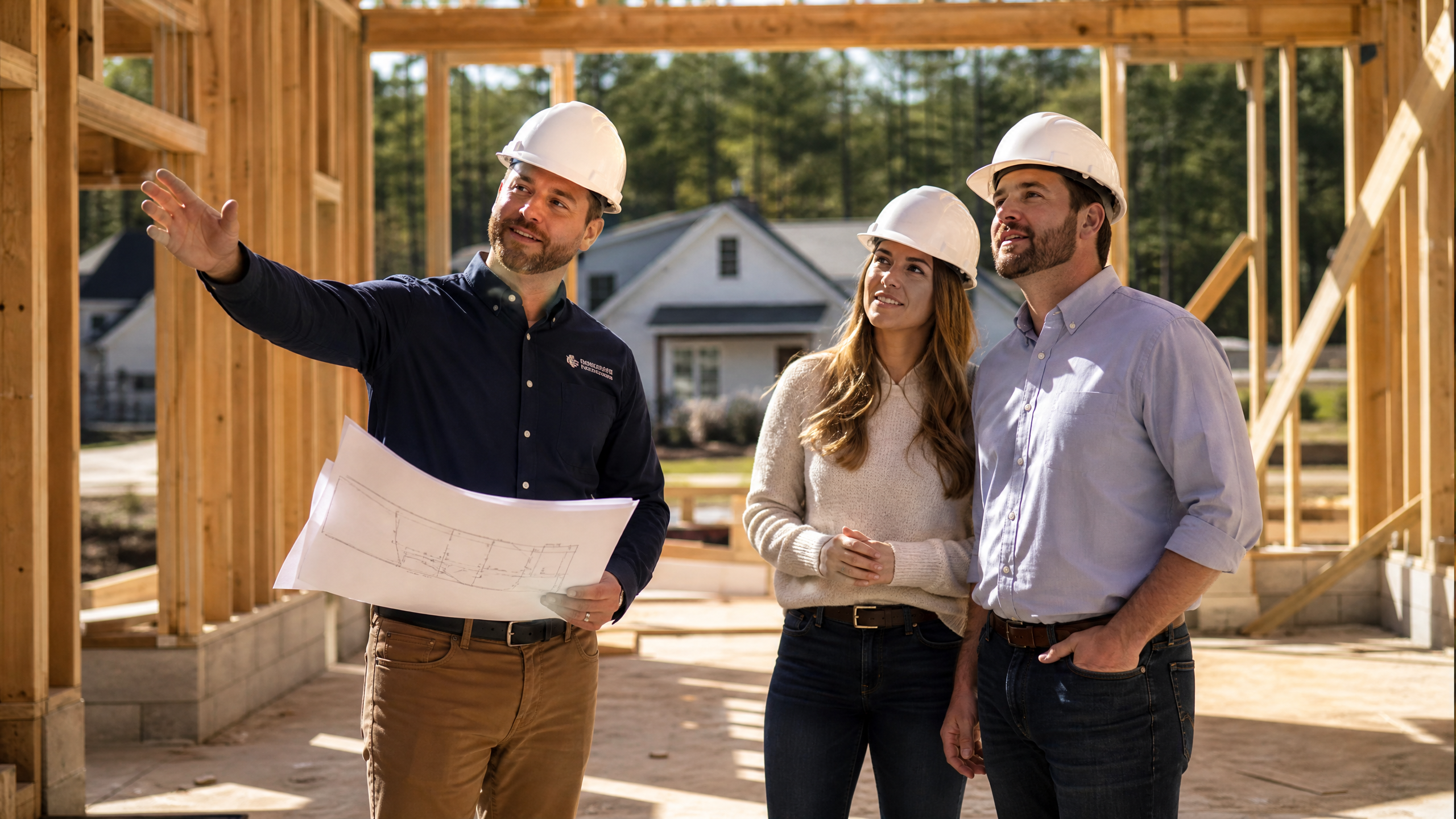
You've done your research. You've toured model homes. You've fallen in love with a community. And now the builder's sales agent is sitting across from you with a contract, a pen, and a smile — telling you everything is standard and there's nothing to worry about.
Here's what they won't tell you: that agent works for the builder, not for you.
In Fayette and Coweta County — where communities like Trilith, Bernhard Farms, Arbor Springs, and Belle Hall are attracting buyers from across metro Atlanta — this distinction matters more than most buyers realize. The builder's on-site agent is a licensed professional whose fiduciary duty runs to their employer: the builder. Their job is to sell homes at the best price and terms for the builder. Your interests are secondary by design.
This guide explains exactly what you risk without your own representation — and what a buyer's agent does to protect you in a new construction transaction.
The Builder's Agent Is Not Your Agent
When you walk into a model home and the on-site sales agent greets you warmly, answers your questions, and helps you pick your lot and floor plan, it feels like they're on your side. In many ways, they are helpful — they know the community, the builder's process, and the available inventory better than anyone.
But "helpful" and "representing your interests" are not the same thing.
A builder's sales agent is a seller's agent. Under Georgia real estate law, they owe their fiduciary duties — loyalty, confidentiality, and full disclosure — to the builder. That means:
- They are not required to disclose information that could hurt the builder's negotiating position.
- They will not advise you to walk away from a deal that isn't in your best interest.
- They will not negotiate against their own employer on your behalf.
- They may represent dual agency — working for both the builder and you simultaneously — which dilutes their ability to advocate for either party fully.
None of this makes them dishonest. It simply means the system is not designed to protect you — and you need someone whose job it is to do exactly that.
Touring a new construction community in Fayette or Coweta County?
Bring your own representation before you sign anything. Israel Nelson is a RamseyTrusted® Realtor with deep knowledge of every active builder in the area.
Schedule a Free Strategy Call →5 Things a Builder's Agent Won't Tell You
1. The Contract Is Written to Protect the Builder
Builder contracts are long, detailed, and drafted by the builder's legal team. They are not the standard Georgia Association of Realtors purchase agreement you'd use in a resale transaction. Key clauses to watch for include:
- Arbitration clauses that waive your right to sue in court if something goes wrong after closing.
- Change order provisions that allow the builder to substitute materials or finishes without your approval.
- Delay clauses that give the builder unlimited time extensions with no financial penalty to them.
- Deposit forfeiture terms that let the builder keep your earnest money if you back out for reasons that would be protected in a standard resale contract.
- Warranty limitations that restrict what the builder is responsible for repairing after you move in.
A buyer's agent who works regularly with new construction — and who has reviewed dozens of builder contracts — will flag these clauses before you sign and negotiate modifications where possible.
2. You Can Negotiate More Than You Think
Builders present their pricing and incentive packages as fixed, but they rarely are. Especially in a market where builders are managing inventory and cash flow, there is often room to negotiate:
- Closing cost contributions — builders frequently offer $10,000–$30,000 toward closing costs, but only if you ask (or only if your agent asks).
- Lot premiums — the premium for a corner lot, cul-de-sac, or wooded view is often negotiable, particularly on lots that have been sitting.
- Upgrades — finished basement, extended garage, upgraded appliance package — these are negotiating chips, not fixed costs.
- Rate buydowns — many builders in 2025–2026 are offering mortgage rate buydowns of 1–2 points to help buyers qualify. An experienced agent knows how to structure this to your maximum benefit.
The builder's agent has no incentive to offer you more than the minimum. Your buyer's agent's entire job is to get you more.
3. The Preferred Lender May Not Be Your Best Option
Almost every builder has a preferred lender — often a captive mortgage company they own or have a financial relationship with. Builders frequently tie their best incentives to using this lender, which creates a real dilemma for buyers.
The problem: the preferred lender's rates and fees are not always competitive. In some cases, the $10,000 closing cost credit the builder offers for using their lender is offset by a higher interest rate that costs you $15,000 more over the life of the loan.
A buyer's agent will help you run the math — comparing the builder's incentive package against an independent lender's offer — so you can make a genuinely informed decision rather than being pressured into a package that benefits the builder's affiliate.
4. A New Home Still Needs an Independent Inspection
Many buyers assume that because a home is brand new, it doesn't need an inspection. This is one of the most expensive assumptions in real estate.
New construction homes regularly have issues: improperly installed HVAC systems, grading problems that direct water toward the foundation, electrical wiring errors, and framing defects that pass municipal inspection but would be caught by a thorough independent inspector. Municipal code inspectors are checking for minimum compliance — not for your best interests.
A buyer's agent will insist on an independent inspection at key phases of construction (pre-drywall is the most important) and will use inspection findings as leverage to get the builder to correct issues before closing rather than after.
5. Your Deposit Is at Risk Without Proper Protections
New construction earnest money deposits are typically larger than resale — often 1–3% of the purchase price, sometimes more for custom builds. On a $700,000 home in Trilith or Bernhard Farms, that's $7,000–$21,000 at risk.
Builder contracts often have narrow contingency windows and strict forfeiture clauses. If your financing falls through, if the appraisal comes in low, or if you need to back out for any reason, the terms governing whether you get your deposit back are entirely determined by the contract language — language the builder's team wrote.
Your buyer's agent negotiates these protections into the contract before you write the check.
Does Using a Buyer's Agent Cost You More?
This is the question most buyers ask — and the answer, in almost every case, is no.
National and regional builders in Fayette and Coweta County — including Jeff Lindsey Communities, Ryan Homes, and Patrick Malloy Communities — have buyer's agent commissions already built into their pricing structure. The commission is paid by the builder at closing, not by you. If you walk in without an agent, the builder does not lower the price — they simply keep the commission.
You are paying for buyer's agent representation whether you use it or not. The only question is whether you get the benefit of it.
What a Buyer's Agent Actually Does in New Construction
Beyond contract review and negotiation, a buyer's agent who specializes in new construction provides value at every stage of the process:
- Community selection — helping you compare communities, builders, and locations based on your priorities (school district, commute, resale value, HOA structure).
- Builder due diligence — researching the builder's reputation, warranty track record, and any complaints filed with the Georgia Secretary of State or BBB.
- Lot selection strategy — advising on which lots in a community will hold value best at resale (corner lots, cul-de-sacs, and lots backing to greenspace consistently outperform interior lots).
- Upgrade ROI analysis — identifying which builder upgrades add resale value (hardwood floors, kitchen packages, primary bath upgrades) versus which are overpriced relative to what you could add yourself after closing (light fixtures, landscaping, window treatments).
- Timeline management — keeping the builder accountable to the construction schedule and coordinating with your lender on rate lock timing, which is critical in a new construction transaction that can take 6–12 months to close.
- Closing walkthrough — conducting a thorough pre-closing walkthrough to document every item that needs to be corrected before you take possession, and ensuring the builder completes the punch list before you sign.
New Construction Communities in Fayette and Coweta County
If you're exploring new construction in the south metro Atlanta area, here are the active communities Israel Nelson works with regularly in the $500K–$1.5M range:
Fayette County: Trilith (from $700s), Bernhard Farms (from mid $900s), Bowers Farm (from $800s), Arborvale (from $625K), Laurel Brooke in Peachtree City (from $950K), and The Manor in Tyrone (from high $900s).
Coweta County: Arbor Springs (from $800s), Belle Hall (from mid $500s), Ellerbe (from $600s), Highgate (from $600s), Lamar Farms (from $700s), Fox Hall in Senoia (from $600s), and Grove Park in Senoia (from $600s).
Each of these communities has different contract terms, incentive structures, and builder relationships. Having an agent who knows the nuances of each builder — and has negotiated with them before — is a significant advantage.
The Bottom Line
Buying new construction is not simpler than buying a resale home — it's more complex. The contracts are longer, the timelines are longer, the deposit risk is higher, and the party on the other side of the table has a team of professionals whose job is to protect the builder's interests.
You deserve the same level of professional representation.
Israel Nelson is a RamseyTrusted® Realtor with The Nelson Group at Drake Realty of Greater Atlanta. He has helped buyers navigate new construction transactions across Fayette and Coweta County — from lot selection through closing — and he knows every active builder and community in the area. His representation costs you nothing at closing. The builder pays it.
Before you tour your next model home, schedule a free strategy call to understand exactly what you're walking into — and how to get the best possible deal.
Thinking About Buying New Construction?
Before you sign anything, it's worth understanding how the right representation can protect your money and your timeline.